Content
When customers ask me to compare nylon vs polyester rope vs polypropylene rope, they’re usually trying to avoid two expensive mistakes: picking a rope that behaves unpredictably under load, or choosing a material that degrades in the actual environment (sun, saltwater, chemicals, abrasion). As a rope manufacturer and supplier, I focus on the differences that show up on the job—how the rope stretches, how it handles shock, how it holds up outdoors, and how it feels in the user’s hands.
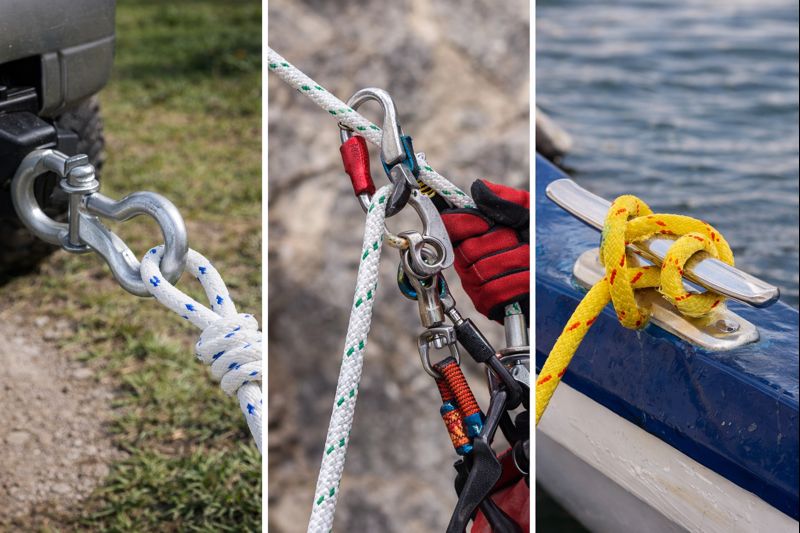
If you want a fast, practical filter, this is how I guide most buyers:
If you’d like to see the full ranges we manufacture, you can review our nylon rope page, our polyester rope page, and our polypropylene rope page.
Two terms drive most purchasing decisions: breaking load (the force where failure occurs) and elongation behavior (how much the rope “gives” while carrying a load). Buyers often compare breaking loads across materials, but the better question is: how much movement can your system tolerate, and what happens during a sudden load event?
| Diameter | Nylon braided rope | Polyester braided rope | PP braided rope |
|---|---|---|---|
| 10 mm | 23 kN (≈2.3 tf) | 20 kN (≈2.0 tf) | 20 kN (≈2.0 tf) |
| 12 mm | 33 kN (≈3.4 tf) | 29 kN (≈3.0 tf) | 29 kN (≈3.0 tf) |
| 16 mm | 59 kN (≈6.0 tf) | 51 kN (≈5.2 tf) | 51 kN (≈5.2 tf) |
In our production experience, the “winner” on paper is not always the winner in the field. Nylon’s key advantage is that it can stretch and recover under variable forces—this elasticity can reduce peak loads during a sudden pull or shock event. Polyester is commonly selected when the customer wants the rope to stay stable under tension with minimal movement. Polypropylene can be a strong fit when weight and floatability matter more than precision control.
My recommendation for procurement is to specify the load case in plain language (static holding, controlled lowering, towing with shock, repeated cycling) and then match the material to the behavior. If you share your application and target diameter, I typically propose a construction and provide a matching parameter table for verification.
Most early rope failures I see are not “strength problems.” They’re environment problems—sun exposure, saltwater, chemical contact, and thermal limits. Material choice is your first line of defense.
If the rope will be used around water, polypropylene has a structural advantage: it is very light in density (0.89–0.92 g/cm³), which supports natural floatability and easier retrieval in rescue or marine scenarios. Nylon and polyester are heavier in specific gravity (nylon around 1.14, polyester around 1.38), so they are typically selected for their handling and load behavior rather than buoyancy.
For PP rope projects with thermal constraints, I ask customers to consider the published polymer limits: a melting point around 164–176°C and a stated use temperature range of -30°C to 140°C. In chemically active environments, polypropylene is often chosen for its chemical stability and practical performance in seawater operations, while polyester is valued for chemical stability and light resistance in many industrial settings.
Even when a rope meets the load requirement, operators will reject it if it’s difficult to manage or if it accelerates wear on hardware. This is where construction and surface feel matter as much as the polymer.
Nylon is commonly recognized for its strong wear resistance and flexibility; in braided constructions, that can translate into smooth handling and stable tension distribution. Polyester braided rope is frequently specified with low elongation and strong wear resistance in work-protection and positioning scenarios. Polypropylene can be engineered for durability as well, and in braided forms it is often chosen when users want a lighter rope that is still practical under abrasion.
In certain lifting and handling environments, customers choose nylon because it is light, wear-resistant, and described as not producing sparks, making it a practical substitute where steel wire rope is undesirable and where protecting painted surfaces matters. For these projects, I recommend confirming the rope construction, end termination, and safety factor in the specification—not only the material name.
Below is a straightforward selection approach I use with buyers. It is practical, not theoretical, and it reduces back-and-forth during procurement.
If you are unsure which direction to go, I recommend deciding first whether stretch is a feature or a problem in your application. That single decision usually narrows the options quickly.
When you send an RFQ, the fastest way to get a correct quote and a correct rope is to specify more than the material name. In our factory we manufacture braided structures (including multi-strand and diamond weaves) and validate product quality with batch inspection under ISO-aligned processes.
For quick reference while you prepare a request, these are the three material catalogs: our nylon rope page, our polyester rope page, and our polypropylene rope page. If you share your intended use and diameter range, I can align the material and construction to the performance you actually need—without over-specifying cost.

San Ye Road, Si Xiang Sub-district, Hai Ling District, Tai Zhou City, Jiang Su Province, China

+86 151-5262-8620
Copyright @ Taizhou KA Protection Products Co., Ltd. All Rights Reserved



 English
 Español
 عربى
عربى
